Business Plan
Simulated Business
Max Lionel Realty

Table of Content
Chapter 1 – Business plan (excerpt) 1
Chapter 2 – Organisational chart and management profiles 4
Chapter 3 – Management responsibilities 6
Chapter 4 – Budget summary 8
Chapter 5 – Operational plan 9
Chapter 6 – Operational risk register 11
Chapter 7 – Work Health and Safety (WHS) Policy 13
Chapter 8 – Anti-discrimination policy 15
Chapter 9 – Procurement policy and procedures 17
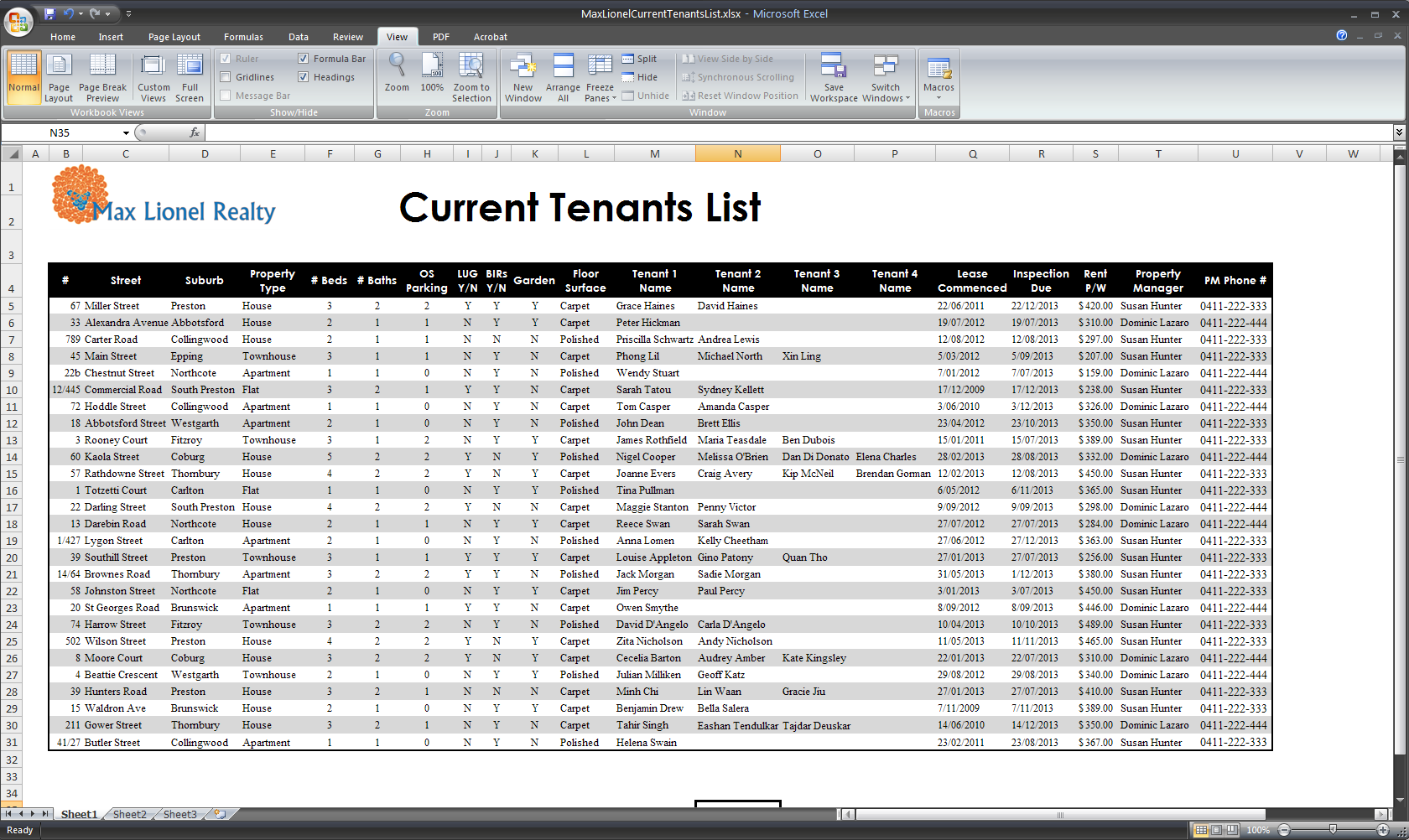
Chapter 10 – Max Lionel Realty current tenants list 24
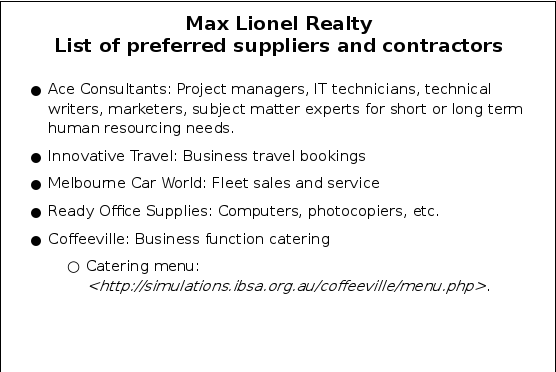
Chapter 11 – List of pre-approved suppliers 25
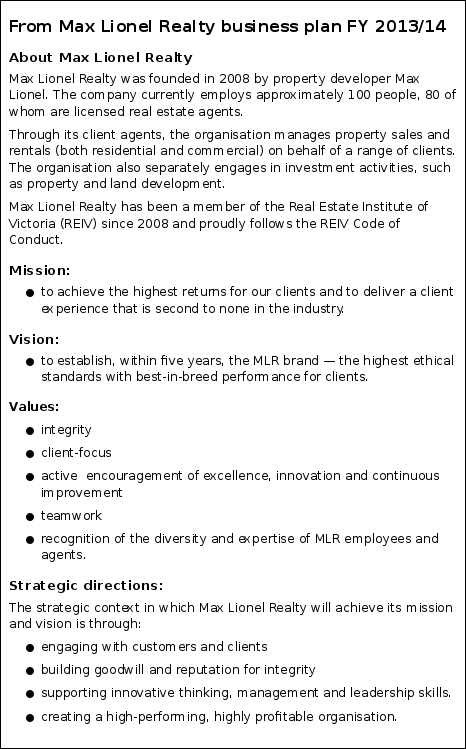
Chapter 1 – Business plan (excerpt) 1
Chapter 2 – Organisational chart and management profiles 2
Chapter 3 – Management responsibilities 3
Chapter 4 – Budget summary 4
Chapter 5 – Operational plan 5
Chapter 6 – Operational risk register 7
Chapter 7 – Work Health and Safety (WHS) Policy 8
Chapter 8 – Anti-discrimination policy 10
Chapter 9 – Procurement policy and procedures 11
Chapter 10 – Max Lionel Realty current tenants list 16
Chapter 11 – List of pre-approved suppliers 17

Max is responsible for working with the Board of Directors to oversee the business, set overall strategic directions, manage risk, and authorise large financial transactions.
Riz Mehra, Chief Financial OfficerRiz is responsible for preparing quarterly financial statements and overall budgeting. Riz Is also responsible for overseeing budgets for cost centres and individual projects. At the completion of financial quarters and at the end of projects, Riz is responsible for viewing budget variation reports and incorporating information into financial statements and financial projections.
Kim Sweeney, Operations General ManagerKim is responsible for the day-to-day running of the company. Kim oversees the coordination, as well as the structural separation, of the Residential, Commercial, and Investments centres. Kim is responsible for sponsoring projects which affect operations of the organisation as a whole. Kim works with the Human Resources Manager to coordinate systems and projects in order to achieve company-wide synergy.
Les Goodale, Human Resources ManagerLes is responsible for the productive capacity and welfare of people at MLR. With the Operations General Manager, Kim works to coordinate projects and management systems such as performance management, recruitment, and induction. Kim will need to ensure aspects of the recently launched WHS management system, such as risk assessment, management, consulting, reporting and continuous improvement, are coordinated with all subsequent activities.
Sam Lee, Manager Residential RealtySam is responsible for the management of all aspects of residential realty. Sam manages the activities of residential agents.
Pat Misfud, Manager Commercial RealtyPat is responsible for the management of all aspects commercial realty. Pat manages the activities of commercial agents.
Peter Mitchell, Manager InvestmentsPeter is responsible for the management of all aspects investment realty. Peter manages the activities of investment agents. Peter works with the Operations General Manager to ensure separation of investment from obligations to residential and commercial clients.
Chapter 4 – Budget summary Max Lionel Realty 2013–2014 budget by activities to be undertaken| Income: |
| |
| Commissions, fees from clients | $2,566,000 | Commissions and agents’ fees for the period. |
| Investment income | $1,567,000 | Real estate investment income. |
| COGS | $150,413 | Cost of provision of services. |
| Total Income | $3,982,587 | Gross profit. |
|
|
| |
| Expenses: |
| |
| Wages, salaries and on costs | $1,567,890 | Wages, salaries, superannuation, work cover insurance, payroll tax. |
| Consultancy fees | $50,000 | Project management: WHS management system; AD awareness program. |
| Communication expenses | $42,000 | Telephone, ISP costs, IT support. |
| Staff travel, transport and accommodation. | $55,500 | Cost of staff travel and associated costs for sales, etc. |
| Premises expenses | $250,000 | Rent, electricity, maintenance, cleaning. |
| Capital expenditure | $120,000 | Purchase of new office equipment (90%), vehicles; purchase of properties, land. |
| Depreciation and amortisation | $177,569 | Computers and capital equipment that is depreciated. |
| Office supplies | $65,068 | Printing and stationery, postage, amenities. |
| Professional fees (consultants, legal and audit), insurances, taxes and charges, subscriptions and memberships. | $62,187 | Audit fees, external accounting costs, bank charges, insurance except workers compensation. |
| Total Expenses | $2,390,214 | |
| Surplus | $1,592,373 | Net income before tax. |
Max Lionel Realty operational plan (summary) FY 2013 - 2014
Objectives:
Performance measures
Tasks:
1
Engage with customers/build ethical profile:
raise organisational profile by 20%
improve client satisfaction performance by 25%.
Percentage of brand recognition in sought-after categories in periodic customer surveys.
Percentage of customers with positive view of organisational responsiveness, innovation, quality.
Number of client/tenant complaints.
Project to raise awareness of anti-discrimination, WHS and other legislation/codes of conduct among agents, clients, tenants.
Conduct of quarterly surveys: clients and tenants.
Training needs analysis and training of agents.
Ensure agents disclose potential conflict of interest to clients, tenants.
Development of ethical charter, including principles all agents must follow.
2
Increase revenues by 20% within the third quarter.
Total income.
Agent income.
Investment income.
Investigate resourcing needs: number of agents; personnel; office equipment, cars, etc.
Fulfil resourcing needs in accordance with policies and procedures.
3
Reduce direct and indirect costs of operations by 10%.
General ledger accounts; financial statements:
wages
cost of agent services
consultancy fees
wastage and associated expenses.
Renegotiate with suppliers.
Research potential new suppliers.
Management engagement with employees to achieve greater employee support of organisational goals.
Include explanation of how activities work with organisational strategic goals in all communications to internal personnel.
Greater use by managers of budgets to encourage restraint.
Greater focus on budget restraint in management of projects.
4
Engage workers with strategic goals of business and support professional development in line with strategic goals. (Targets to be set by individual managers.)
Percentage completion of performance plans and performance management process.
Numbers of coaching sessions completed.
Numbers of operational – related training programs completed.
Management engagement with employees to achieve greater buy in of organisational goals.
Include explanation of how activities work with organisational strategic goals in all communications to internal personnel.
Regular coaching.
Training needs analysis and training.
Strategic goals included in induction program for estate agents.
Employee incentives for performance in all areas relevant to operational and strategic goals.
5
Improve health of employees (range of specific areas).
Numbers of injuries (Target = 0).
Numbers of absentees
(Target = <3% of total hours).
Training need analysis and training on WHS and implementation of recently launched MLR WHS management system.
Research incentives for: safe work achievement and healthy lifestyle.
Max Lionel Realty risk register FY 2012/2013
Identified risk
Probability
Impact
Current controls
Future actions
Failure to recruit qualified real estate agents due to increased competition.
Medium
High
All office equipment regularly reviewed and updated as required; IT security monitored and maintained.
Appropriate insurances held and coverage reviewed annually.
Managers encouraged and incentivised to follow performance management policy.
Employee performance plans align with business plan and six-monthly review process in place.
Project to raise awareness of anti-discrimination, WHS and other legislation/codes of conduct among agents, clients, tenants
Appropriate HR policies and procedures in place.
WHS management system in place.
Industry benchmarking in all areas of organisational performance
Conduct periodic reviews of agent performance to ensure professional conduct
Staff trained in use of technology as needed.
Keep abreast of changes in potential liabilities.
Review and develop HR related policies where required.
Development of ethical charter, including principles all agents must follow
Failure to realise revenue gains due to recent slump in real estate prices.
High
High
Inadequate insurance cover.
Low
High
Non-compliance on anti-discrimination.
Medium
High
Perception of discriminatory practice reducing client and tenant base.
Medium
High
Poor organisational culture; low level of staff engagement and morale.
Medium
Medium
Loss of knowledge and capability through departing staff.
Low
High
Failure to meet occupational health and safety requirements.
Low
High
Max Lionel Realty recognises its responsibility to provide a healthy and safe working environment for employees, contractors, clients and visitors. Max Lionel Realty is committed to the continued wellbeing of its employees and to ensuring that all employees are safe from injury and health risks whilst undertaking work-related duties, including home-based work.
| Purpose | The purpose of this policy is to ensure the acquisition of resources is carried out consistently, fairly and transparently and in accordance with organisational requirements. In order to ensure a healthy and safe working environment, Max Lionel Realty will (in accordance with the WHS management system):
|
| Scope | The scope of this policy covers employees and contractors of Max Lionel Realty (MLR). |
| Resources | Specific procedures for the implementation of this policy are available below and on the company intranet. |
| Responsibility | Max Lionel Realty management and employees are ultimately responsible for ensuring that safe systems of work are established, implemented and maintained. Management is responsible for:
|
| |
Individual employees are responsible for:
|
| Policy Implementation and Review | This policy has been established and implemented through the human resource functions of the organisation and will be reviewed regularly in consultation with MLR management and employees to ensure compliance with legislation, industry standards and organisational changes. |
| Relevant legislation, etc. |
|
| Updated/ authorised | 10/2013 – Riz Mehra, CFO |
| Purpose | The purpose of this policy is to ensure transactions with clients, tenants and other employees is handled fairly and transparently and in accordance with organisational and legal requirements. Generally it is unlawful to discriminate on the basis of the following 16 characteristics: | |
|
| |
| Scope | The scope of this policy covers all employees and contractors of Max Lionel Realty (MLR). | |
| Resources | Specific procedures for the implementation of this policy are available below and on the company intranet. | |
| Responsibility | Responsibility for the implementation of this policy rests with all employees, contractors and management of Max Lionel Realty. | |
| Relevant legislation, etc. |
| |
| Updated/ authorised | 10/2013 – Riz Mehra, CFO | |
| Purpose | The purpose of this policy is to ensure the acquisition of resources is carried out consistently, fairly and transparently and in accordance with organisational requirements. |
| Scope | The scope of this policy covers the purchasing and acquisition of resources by employees and contractors of Max Lionel Realty (MLR). |
| Resources | Specific procedures for the implementation of this policy are available below and on the company intranet. |
| Responsibility | Responsibility for the implementation of this policy rests with employees and management of Max Lionel Realty with responsibility for purchasing resources. |
| Relevant legislation etc. |
|
| Updated/ authorised | 10/2013 – Riz Mehra, CFO |
The principle of probity and ethical behaviour governs the conduct of all procurement activities. Employees who have authority to procure goods and services must comply with the standards of integrity, probity, professional conduct and ethical behaviour. Employees or directors must not seek to benefit from supplier practices that may be dishonest or unethical.
2. Value for moneyValue for money is the core principle underpinning procurement. Contracted organisations must be cost effective and efficient in the use of resources whilst upholding the highest standards of probity and integrity. In general, a competitive process carried out in an open, objective and transparent manner can achieve the best value for money in procurement.
3. Non-discriminationThis procurement policy is non-discriminatory. All potential contracted suppliers should have the same opportunities to compete for business and must be treated equitably based on their suitability for the intended purpose.
4. Risk managementRisk management involves the systematic identification, analysis, treatment and, where possible, the implementation of appropriate risk-mitigation strategies. It is integral to efficiency and effectiveness to proactively identify, evaluate, and manage risks arising out of procurement related activities. The risks associated with procurement activity must be managed in accordance with the organisation’s risk management policy.
5. Responsible financial managementThe principle of responsible financial management must be applied to all procurement activities. Factors that must be considered include:
the availability of funds within an existing approved budget
staff approving the expenditure of funds strictly within their delegations
measures to contain costs of the procurement without compromising any procurement principles.
In order to achieve value for money, each procurement process must be well planned and conducted in accordance with the principles contained in this document and comply with all of the organisation’s policies and relevant legal and regulatory requirements.
When planning appropriate procurement processes consideration should be given to adopting an approach that:
encourages competition
ensures that rules do not operate to limit competition by discriminating against particular suppliers
recognises any industry regulation and licensing requirements
secures and maintains contractual and related documentation for the procurement which best protects the organisation
complies with the organisation’s delegations policy.
Employees who are involved in procurement activities must make a conscious effort to maximise opportunities for Australian manufacturers and suppliers to provide products where there is practicable and economic value. In making a value for money judgement between locally-made and overseas-sourced goods, employees are to take into account:
whole-of-life costs associated with the good or service
that the initial purchase price may not be a reliable indicator of value
the quality of locally made products
the record of performance and delivery of local suppliers
the flexibility, convenience and capacity of local suppliers for follow on orders
the scope for improvements to the goods and ‘add-ons’ from local industry.
Max Lionel Realty shall maintain a pre-registered list of preferred suppliers, following a request for expressions of interest and an evaluation of the submissions. Suppliers can request to be evaluated for inclusion on the existing pre-register list at any time.
All purchases under $5,000 may be made from preferred suppliers without undertaking a competitive process. Purchases above $5,000 where a preferred supplier exists should include a competitive process if practicable.
This list is reviewed at regular intervals with admission of interested parties on a rolling basis. Care should be taken to ensure that such lists are used in an open and non‑discriminatory manner. Max Lionel Realty encourages new contractors to provide information on their experience, expertise, capabilities, pricing, fees, and current availability. It is in the interest of the organisation that the pool of potential suppliers is actively maintained and updated. Employees should be encouraged to provide reports of their experiences in working with each contractor/consultant to assist future decisions concerning commissioning suitable contractors and consultants.
9. Avoid conflict of interestEmployees and directors are required to be free of interests or relationships in all aspects of the procurement process. Employees and directors are not permitted to personally gain from any aspect of a procurement process.
Employees and directors shall ensure that to the best of their knowledge, information and belief, that at the date of engaging a contractor no conflict of interest exists or is likely to arise in the performance of the contractor’s obligations under their contract.
Should employees or directors become aware of potential conflicts of interest during the contract period, they must advise the CEO and the Board of Directors immediately.
Prior to any situation arising with potential for a conflict of interest, complete disclosure shall be made to the CEO and the Board of Directors to allow sufficient time for a review.
10. Report collusive tenderingEmployees should be aware of anti-competitive practices such as collusive tendering. Any evidence of suspected collusion in tendering should be brought to the attention of the CEO and the Board of Directors.
11. Competitive processIt is a basic principle of procurement that a competitive process should be used unless there are justifiable circumstances. For purchases under $5,000, the list of preferred suppliers may be used. The type of competitive process can vary depending on the size and characteristics of the contract to be awarded.
12. Direct invitation (selective or restricted tendering)A process of direct sourcing to tender may be used. This may involve:
an invitation to organisations deemed appropriately qualified for a particular product or service (this may be appropriate for specialised requirements in markets where there is a limited number of suppliers or service providers)
an invitation to tender to organisations on MLR’s pre-registered list of preferred suppliers if applicable.
For projects being awarded, consideration will be given not only to the most economically advantageous tender, but also to the track record of the tender respondent and the degree of confidence that the panel has in the quality if the bid. It will be the normal practice to have the evaluation of tenders carried out by a team with the requisite competency.
14. Results of tendering processAll tender respondents should be informed in writing of the result of a tendering process immediately after a contract has been awarded.
Summary of procurement policy delegationsAuthority
Purchase amount
Required number of quotes
Comment
CEO and one Director
Authority to sign contracts for products and services over $75,000.
Two or more competitive quotes for contracts over $75,000.
Detailed services contract required.
CEO
Authority to sign contracts for products and services up to $75,000.
Two or more competitive quotes.
Detailed services contract required for contracts over $20,000.
General Managers
Delegated authority only through CEO
Authority to sign contracts for products and services under $30,000.
One or more competitive quotes preferred.
Provided they are within the approved budget and consistent with business/operational and strategic planning.
Managers
Authority to sign contracts for products and services under $10,000.
One or more competitive quotes preferred.
Follow MLR purchasing procedures.
Agents
Authority to sign contracts for products and services under $5,000.
Must use preferred suppliers list.
Follow MLR purchasing procedures.
Contractors and external consultants
No authority.
One or more competitive quotes preferred.
Must use preferred suppliers list.
Contractors and external consultants must follow MLR purchasing procedures and must seek approval for purchases from person holding relevant authority.