MKT 571; Social, Ethical, and Legal Implications PowerPoint Presentations
0
Introduction
Facebook wishes to introduce a new type of service in the market that centers on the company’s data collecting abilities and its large-scale database of active users. The new service predicts the consumers’ food demands in real time and responds to them by letting consumers order food directly from the Facebook website. The new service to edge out competitors and branding is important. Facebook needs a communication plan to highlight details of how Facebook will advertise the new product to consumers and types of media to use. History shows us doing an excellent service is just one part of ensuring success, proper marketing ensures users are aware of the value the product adds to their lives and that they can get the service whenever they demand it (Aaker & Biel, 2013).
Situational analysis
The vision behind a new product Facebook plans to roll out is to use its analytical capabilities and database to introduce a service that predicts the demand of consumers and reacts to them. The mission of the new product is to serve the needs of all users using the data provided to Facebook. Facebook analyses this data and uses it to predict what a consumer may require in the future. The strategic objectives behind the new product are too perfect Facebook’s analytics system to perfectly predict consumer demand. Another strategic goal is to diversity Facebook’s income stream in a market nearing capacity. The values of the new services are quality, convenience, and price.
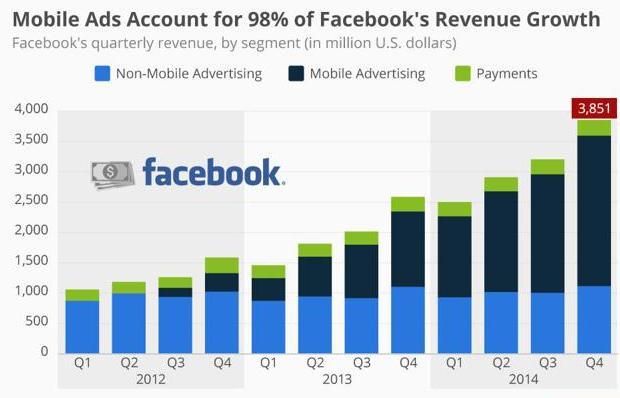
Graph 1: Facebook is overly dependent on advertising and needs to diversify its revenue stream
Facebook already has an iconic brand image all over the world compared to other food delivery companies; this gives Facebook an advantage, as customers are more likely to order from a recognized company.
Despite the strengths, a weakness Facebook has is that it lacks experience in the food delivery business; Facebook has to invest large sums of money to create a delivery system that can meet customer demand efficiently.
Facebook’s competitors have strengths and weaknesses; one strength of Facebook’s competitors is they have vastly more experience in the food delivery. Companies such as Dominoes’ Pizza have perfected the delivery system which delivers Pizza within minutes of ordering; it took plenty of trial and error to reach this level of efficiency (Reisinger & Grohs, 2014). Facebook will work harder than its competitors do to achieve the same degree of efficiency. One weakness of the competitors is they do not have Facebook’s unique insight into the market. Facebook can see shifting consumer demand in real time and capitalize on it.
Product promotion and price strategies
The success of the new product depends on how Facebook can brand and market to the consumer. Facebook has to build a brand identity. Ideally, Facebook would like consumers to associate the new service with convenience and quality; this takes careful advertising and delivery of service. In creating its brand image, Facebook should set clear goals for the branding campaign; the company should then use these goals as guideposts when advertising the new product (Aaker & Biel, 2013). A goal of the branding campaign is to make consumer’s associate the new product with convenience; the company will advertise the service as one that makes it convenient to order food from within the Facebook application. Advertising tells the consumer the features of the new product, for the branding campaign to stick; the company has to deliver on its promises.
A few objectives are:
Users aware of new product
Inform consumers how the product adds value to their lives.
Meet company goals and outlines for its brand
by the end of the advertising campaign, customers should associate the new service with quality and convenience
Proper marketing etiquette
According to University of Phoenix Chapter 21 Publisher Presentation (2017),
Copy should be only 50% of screen
Brands should limit ads to phrase pair
Put brand logo in the corner of ad frame
Use only one of two bright colors
Calls to action should be in a bright color
Facebook needs to achieve these objective by highlighting the convenience and quality this marks success. It will be necessary for the mobile marketing to be on point with bite-size software programs that can be downloaded to smartphones and to be concise. (University of Phoenix, 2017).
References
Aaker, & Biel. (2013). Brand Equity & Advertising: Advertising’s role in building strong brands. Psychology Press.
Anselmsson, & Bondesson. (2014). Brand image and customers’ willingness to pay a price for food brands. Journal of Product & Brand Management, 23(2), 90-102.
Reisinger, & Grohs. (2014). Sponsorship effects on brand image: The role of exposure and activity involvement. Journal of Business Research, 67(5), 1018-1025
University of Phoenix. (2017). Chapter 21 Publisher Presentation. Retrieved from University of Phoenix, Mkt 571 website.
Assignment details not graded!
Assignment Steps
Develop a minimum 700-word branding strategy and marketing communication plan in Microsoft® Word. This document should address at least 5 elements of the Situational Analysis and the Product, Place/Distribution, Promotion, and Price Strategies (modified below) sections of the marketing plan (from the Situational Analysis and the Product, Place/Distribution, Promotion, and Price Strategies lists below). The five elements you select should only come from the options provided below. You must include a measurement of customer loyalty and retention in your strategy document. You may include more than the minimum to provide clarity and coherence to your document.
Situational Analysis:
Vision , Mission, Strategic objectives, Values
Strengths/Weaknesses
Competitor's Strengths/Weaknesses
Market Segments
Product, Place/Distribution, Promotion, and Price Strategies:
Creating a Brand Image
Maintaining Brand Image
Branding Concerns
Promotion/Integrated Marketing Communication
Advertising Strategy/Objectives
Push and Pull
Media Strategy
Advertising Execution
Public Relations/Strategies
Note: Charts/graphs/tables do not count toward the word count.
The plan will be a continuation of your global or multi-regional business you chose in Week 1. This will be incorporated into your overall marketing plan for Week 6.
Grading Guide| Content | Met | Partially Met | Not Met | Comments: |
| Student develops a branding strategy and marketing communication plan that addresses at least 5 elements of the Situational Analysis and the Product, Place/Distribution, Promotion, and Price Strategies (modified below) sections of the marketing plan. Choose 5 elements from the lists below:
|
| |||
| Student must include a measurement of customer loyalty and retention in your strategy document. | ||||
| The branding strategy and marketing communication plan is a minimum of 700 words in length. Note: Charts/graphs/tables do not count toward the word count. | ||||
| Total Available | Total Earned | |||
| #/7 |
| Writing Guidelines | Met | Partially Met | Not Met | Comments: |
| The paper—including tables and graphs, headings, title page, and reference page—is consistent with APA formatting guidelines and meets course-level requirements. | ||||
| Intellectual property is recognized with in-text citations and a reference page. | ||||
| Paragraph and sentence transitions are present, logical, and maintain the flow throughout the paper. | ||||
| Sentences are complete, clear, and concise. | ||||
| Rules of grammar and usage are followed including spelling and punctuation. | ||||
| Total Available | Total Earned | |||
|
| #/3 |
Week 5: Marketing Communication and Brand Strategy
Brand strategy and the communication of the brand is essential to understanding the various phases of a product or service (viz a viz the life cycle). Brand recognition is based in the marketing communication efforts of the firm. When you hear or see the word Coke, you immediately know it is Coca Cola. When you see five interlocking rings of different colors you know that is the symbol for the Olympics. In Week 5, you will develop a brand and communication strategy for your product.